Key concepts to easily understand texts related to heat transfer
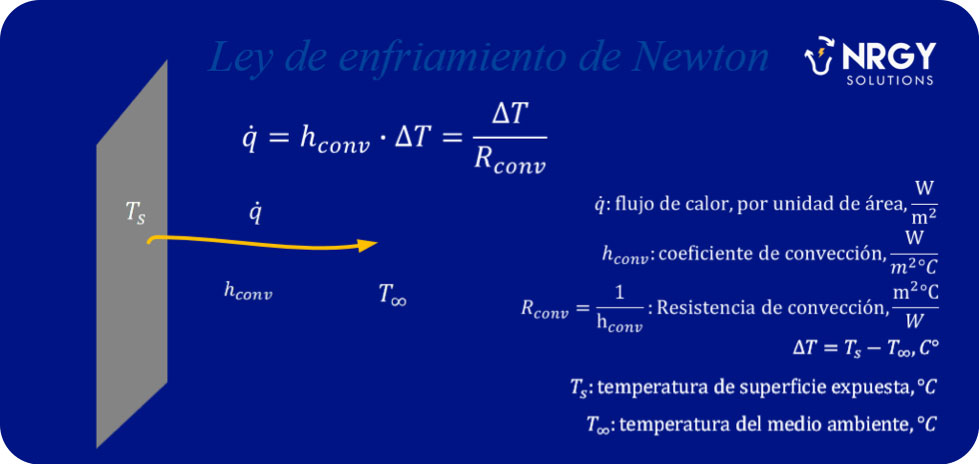
Convection heat transfer coefficient
phrase
El coeficiente de transferencia de calor por convección, h, puede definirse como La tasa de transferencia de calor entre una superficie sólida y un fluido por unidad de superficie por unidad de diferencia de temperatura. Ingeniería térmica
Example: As can be seen, the proportionality constant will be crucial in the calculations and is known as the convection heat transfer coefficient, h . The convective heat transfer coefficient, h, can be defined as:
en: Coeficiente de transferencia de calor por convección
Critical Reynold’s number
phrase
The Reynolds number is the ratio of inertia forces to viscous forces and is a convenient parameter for predicting whether a flow condition will be laminar or turbulent. The critical Reynolds number is associated with the laminar-turbulent transition, in which a laminar flow becomes turbulent.
Example: Influence of the insertion of cylindrical helices on the critical Reynold's number of a flow in an annular space.
en: Número crítico de Reynold
Friction Coefficient
noun
The coefficient of friction or coefficient of friction relates the opposition to sliding offered by the surfaces of two bodies in contact according to the intensity of the mutual support they experience. It is a dimensionless coefficient. It is usually represented by the Greek letter μ (mi).
Example: The coefficient of friction is the ratio between the sliding force and the holding force exerted by two surfaces in contact. This coefficient is in fact an evaluation of the difficulty with which the surface of one material will slide on another material.
en: Coeficiente de fricción
Kinematic viscosity.
noun
Kinematic viscosity is a measure of the internal resistance of a fluid to flow under gravitational forces. This value is converted into standard units such as centistokes (cSt) or square millimeters per second.
Example: Kinematic viscosity is the ratio of dynamic viscosity to density, and is measured in centistokes.
en: Viscosidad cinemática.
Laminar flow
noun
The movement of a fluid is called laminar flow when it is orderly, stratified and smooth. In a laminar flow, the fluid moves in parallel sheets without intermingling and each fluid particle follows a trajectory called streamline.
Example: In laminar flow the lateral transport mechanism is exclusively molecular.
en: Flujo laminar
Nusselt number
noun
The Nusselt number (Nu) is a dimensionless number that measures the increase in heat transfer from a surface through which a fluid flows (convective heat transfer) compared to heat transfer if it occurred by conduction alone.
Example: he Nusselt number can also be viewed as a dimensionless temperature gradient at the surface. In mass transfer the analogous number to the Nusselt number is the Sherwood number.
en: Número de Nusselt
Prandtl number
noun
The Prandtl number (Pr) is a dimensionless number proportional to the quotient of the rate of diffusion of the momentum quantity (viscosity) and the thermal diffusivity.
Example: In heat transfer problems the Prandtl number controls the relative thickness of the momentum and thermal boundary layers. When Pr is small it means that the heat diffuses very fast compared to the velocity (momentum).
en: Número de Prandtl
Reynold number
noun
The Reynold number (Re) is a dimensionless number used in fluid mechanics, reactor design and transport phenomena to characterize the motion of a fluid. Its value indicates whether the flow follows a laminar or turbulent pattern.
Example: The Reynolds number is one of the most important dimensionless numbers in fluid mechanics and, at the same time, one of the most basic. In fact, it is one of the first concepts learned in any fluid mechanics course.
en: Número de Reynold
Shear stress
noun
The shear stress or shear stress is that which, fixed to a plane, acts tangentially to it. It is usually represented by the Greek letter tau { "playstyle" }. In prismatic parts, shear stresses occur when either a shear stress or a torsional moment is applied.
Example: Shear stress , force that tends to cause deformation of a material by sliding along a plane or planes parallel to the imposed stress .
en: tensión cortante
Turbulent flow
noun
Turbulent flow is the movement of a fluid that occurs in a chaotic manner, in which the particles move disorderly and the trajectories of the particles are found to form aperiodic eddies, which occurs in a large number of configurations such as channels, pipes, reactors, whether biochemical, physical or nuclear.
Example: Turbulent flow is characterized by the irregular (one might say chaotic) movement of particles in the fluid. Turbulent flow tends to occur at higher velocities, low viscosity.